

Sapa Heaven Gate sits high on O Quy Ho Pass at around 2,035 meters above sea level. When the clouds stay away, you can look across the Hoang Lien Son mountains, down into the valleys below, and toward Fansipan in the distance. When they do not, much of that view can disappear behind fog.
That uncertainty is worth knowing before making the trip. Sapa town can be clear while the top of the pass is already covered in cloud, so this is one attraction where the weather can make a big difference to what you actually see.
The place itself is developed rather than remote. There are paved walkways, viewing areas, spiritual monuments, and photo spots facing the mountains. You get the high-altitude scenery without having to take on a long trek, although the experience feels very different from walking through the surrounding mountains.
There is also an easy point of confusion when searching for the location online. Sapa Heaven’s Gate and O Quy Ho Pass are not quite the same thing. O Quy Ho Pass is the roughly 50-kilometer public mountain road along National Highway 4D, while Sapa Heaven’s Gate refers to the ticketed tourism complex near the top of the pass. Knowing that distinction makes it much easier to understand where you are actually going.
Sapa Heaven’s Gate at a Glance
| Information | Details |
|---|---|
| Location | O Quy Ho Pass, on the Lai Chau side of the pass beside QL4D |
| Distance from Sapa | Around 15 km northwest from central Sapa |
| Travel time | Around 30 – 40 minutes by motorized transport |
| Best for | Mountain views, cloud hunting, and landscape photography |
| Time needed | Around 1 – 2 hours for the viewing areas and monuments |
| Best weather | Clear or partly cloudy conditions |
| Usual opening hours | Around 7:00 AM – 6:00 PM daily; confirm the last admission time |
| Entrance fee | Around 120,000 VND per adult; check the current rate before visiting |
You may see slightly different distances when planning the trip. The attraction’s official website places it about 15 km from Sapa, while some maps show a shorter or longer route depending on the starting point.
The site is directly along National Highway 4D (QL4D) in the O Quy Ho Pass area. For planning purposes, allowing around 30 – 40 minutes each way from central Sapa is a more useful reference than focusing too much on the exact kilometer figure.
Weather is the other detail worth checking before you leave. With mountain views being the main reason to go, clear or partly cloudy conditions will make a much bigger difference here than a small change in travel time.
- Recommended for you: Best things to do in Sapa
Which “Heaven’s Gate” in Sapa Are We Talking About?
There are several places around Sapa using the name “Heaven’s Gate” (Cổng Trời), including cafés, photo spots, and tourism businesses closer to town. That can make map searches confusing.
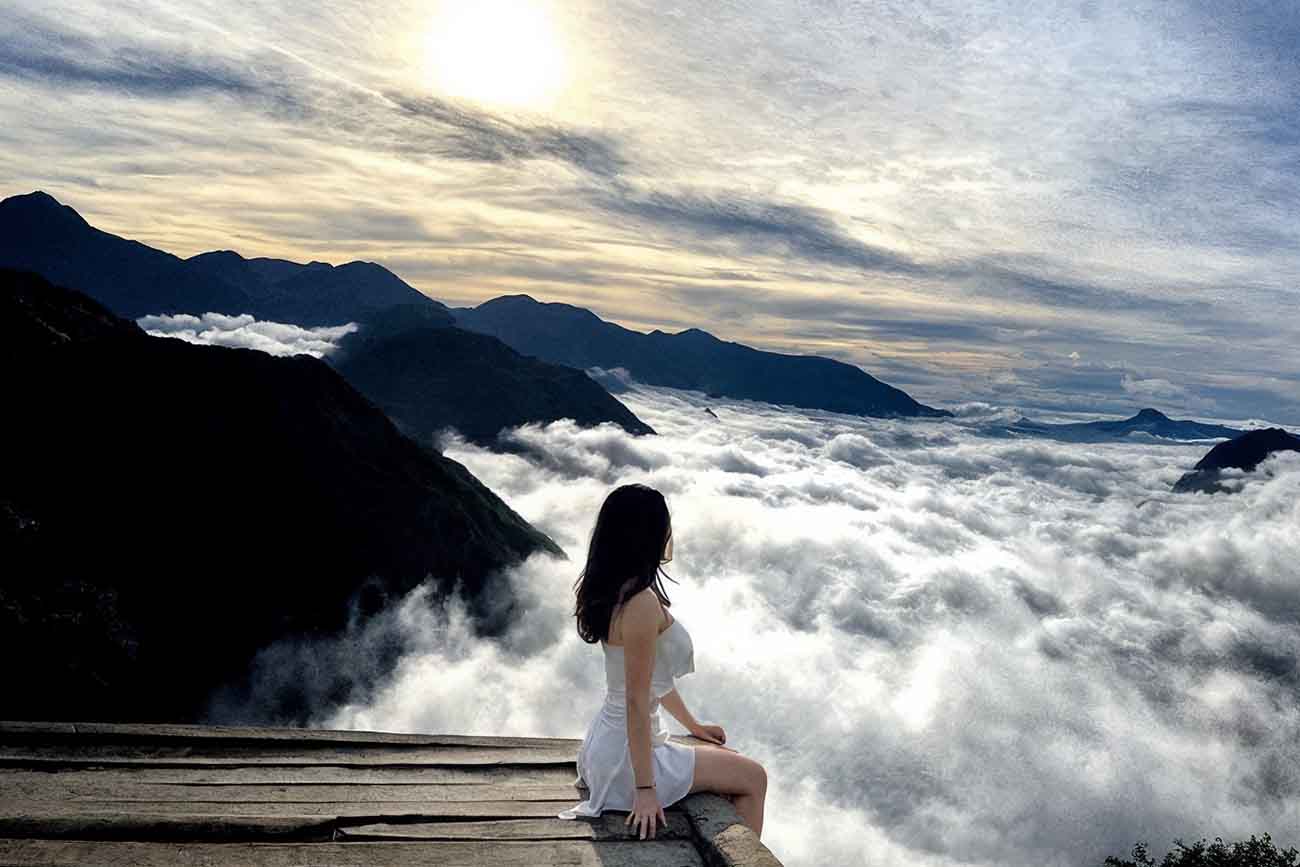
The place covered in this guide is O Quy Ho Heaven Gate (Khu du lịch Cổng Trời Ô Quy Hồ), a ticketed attraction near the top of O Quy Ho Pass at around 2,035 meters above sea level.
This is the viewpoint associated with the wide mountain scenery, cloud views, and sunsets over the pass.
O Quy Ho Heaven Gate
O Quy Ho Heaven Gate sits near the summit area of the pass, where the road crosses the high mountains between Lao Cai and Lai Chau provinces.
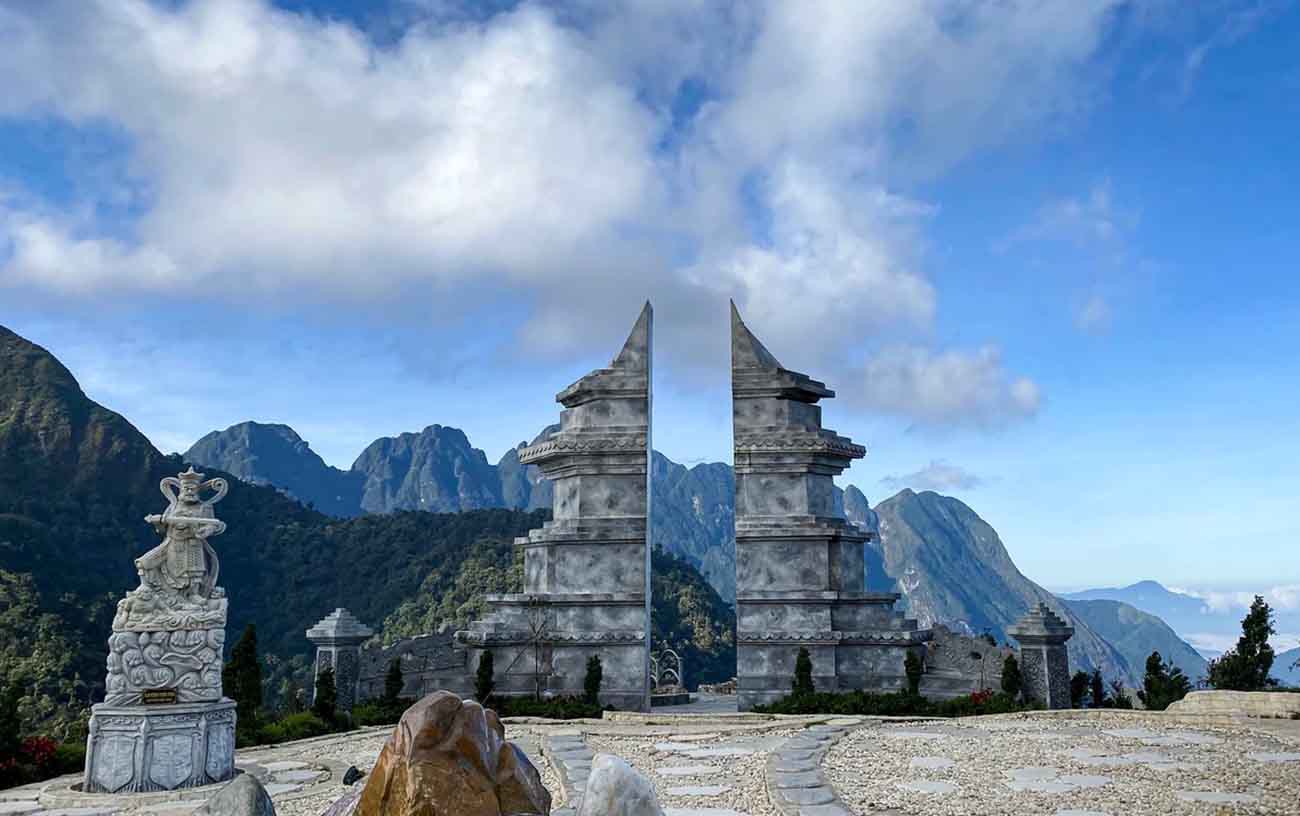
From the viewpoint, the landscape opens out across steep valleys and surrounding ridgelines.
When people talk about watching the sunset or clouds from “Heaven’s Gate” in Sapa, this is the location they usually mean in the context of O Quy Ho Pass.
Heaven Gate vs. O Quy Ho Pass
These two names are closely related, but they describe different things.
O Quy Ho Pass is the mountain road itself. It is a public route used by local traffic, tourists, buses, and trucks.
Heaven Gate is the developed, ticketed viewpoint beside the upper section of that road.
You can still enjoy O Quy Ho Pass without entering the Heaven Gate complex. Use only proper roadside pull-offs or developed viewpoints, since many bends and narrow shoulders are unsafe for stopping.
Paying to enter Heaven Gate gives access to the developed viewing area, higher viewpoints, safety infrastructure, and the cultural and photo installations inside the complex.
So when planning the trip, it helps to think of O Quy Ho Pass as the route and Heaven Gate as one specific stop along it.
Is Sapa Heaven Gate Worth Visiting?
Yes, Sapa Heaven’s Gate is worth visiting if the weather is clear and mountain views are one of the things you want from the trip.
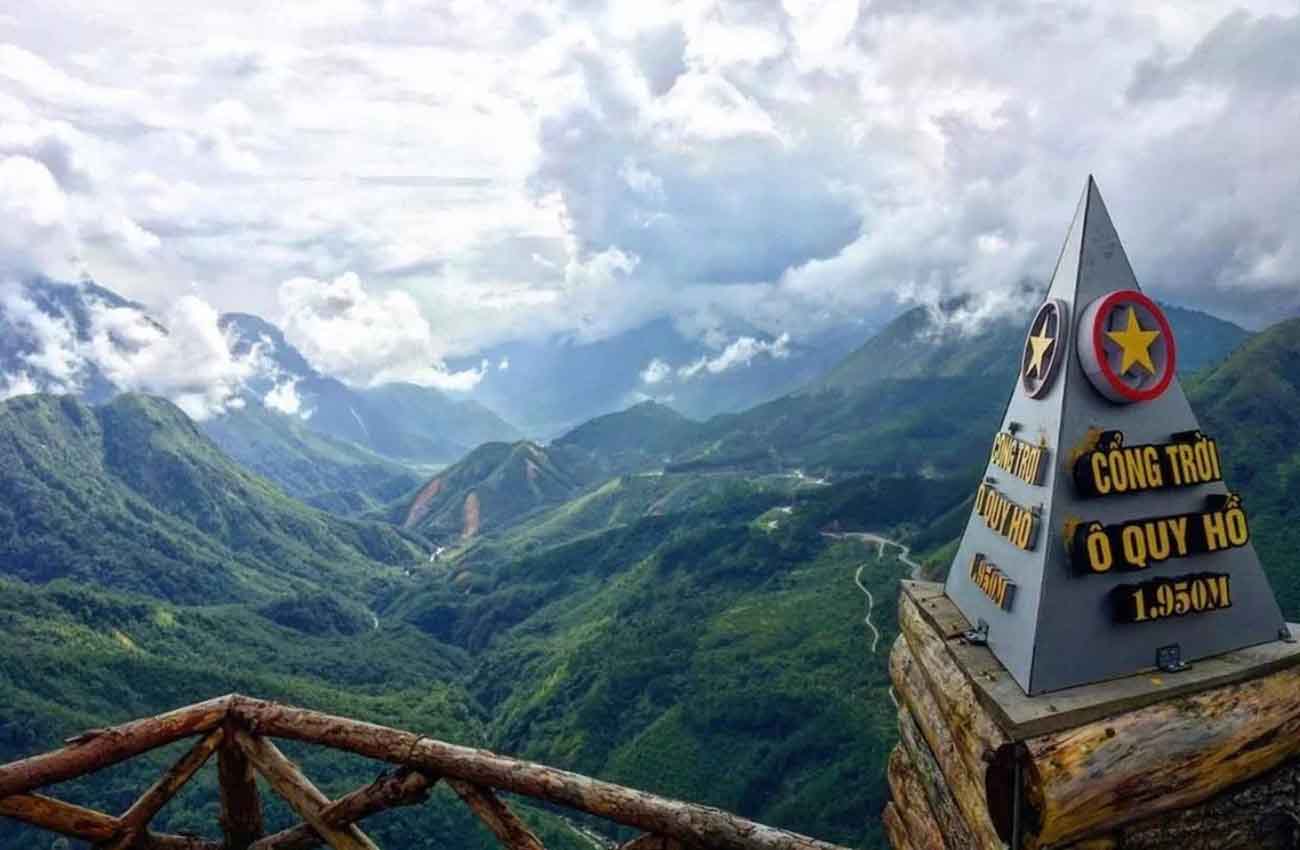
At around 2,035 meters above sea level, the viewpoint gives you access to wide views over the surrounding valleys and ridgelines without requiring a long trek. It also sits along O Quy Ho Pass, so the stop fits easily with other places on the same route.
Who Is Sapa Heaven’s Gate Best For?
Heaven’s Gate makes the most sense if you enjoy mountain scenery but do not want to spend several hours hiking to reach a viewpoint.
The site has paved walkways, viewing areas, and photo spots, so the experience is much easier than a trekking route.
It is also a practical stop if you are already visiting O Quy Ho Pass, Silver Waterfall, or Love Waterfall. Since these places are along the same general route, adding Heaven’s Gate does not require a completely separate trip from Sapa town.
Photographers will probably get more from the site as well. The open mountain views, cloud conditions, and built viewing structures give you several different angles without needing to leave the developed area.
Who Might Want to Skip It?
The biggest reason to skip Heaven’s Gate is heavy fog.
When the viewpoint is completely inside the cloud layer, visibility can drop to only a few meters. In that situation, much of what you are paying to see disappears.
It may also be less worthwhile if you only have a short amount of time in Sapa. The drive from town takes around 30 – 40 minutes, so travelers with a tight itinerary may prefer somewhere closer.
Another thing to consider is the level of development.
Heaven’s Gate is not an untouched mountain viewpoint. The complex includes paved areas, cafés, statues, and designated photo installations. If you prefer natural roadside viewpoints with less infrastructure, you may enjoy O Quy Ho Pass itself more.
You can still see mountain scenery from parts of the public road without buying a ticket.
So I would think of Heaven’s Gate as a good choice for easy access, developed viewpoints, and photography, rather than as a remote wilderness experience.
What to See and Do at Sapa Heaven’s Gate
Sapa Heaven’s Gate is larger than just the gate you often see in photos. The complex spreads across the mountainside, with several viewing areas, terraces, religious structures, and photo spots.
If the weather is good, it is worth walking farther into the site rather than taking a few pictures near the entrance and leaving.
Take in the Views from O Quy Ho Pass
The mountain view is still the main reason to come.
From the viewing areas, you can look down into the valleys below and see sections of the road winding through O Quy Ho Pass. On clearer days, the ridgelines of the Hoang Lien Son range are much easier to see.
Cloudy weather does not always ruin the view. Thin cloud can sit between the mountain layers and change the whole scene.
Thick fog is different. Once the viewpoint is completely inside the cloud, there may be very little landscape left to see.
Go Cloud Hunting
“Cloud hunting,” or săn mây, is especially popular at O Quy Ho.
When the conditions line up, clouds settle in the valleys below while the upper part of the pass remains clear. From the viewpoint, you are looking down over the cloud layer rather than standing inside it.
That is the “sea of clouds” people often hope to see here.
It is not something you can book or guarantee.
Humidity, wind, temperature, and cloud height all affect whether the clouds sit below the viewpoint, disappear completely, or cover the entire mountain.
Check the weather before leaving Sapa, but even then, treat cloud hunting as a bonus rather than something you are certain to get.
Walk Around the Viewpoints
Do not stop at the first photo area.
There are several terraces and viewpoints spread around the complex, connected by paths along the mountainside.
One of the developed areas is the Cloud Yard, with religious and cultural installations including figures of the Four Heavenly Kings.
Continue farther and you can reach O Quy Ho Temple by crossing the Guanyin Bridge.
The temple, statues, and other themed areas give you something to explore while waiting for the clouds to shift, although visitors coming only for natural scenery may find these installations less appealing.
Photograph the Heaven Gate
The large split gate is one of the most recognizable photo spots in the complex.
A lower camera angle can make the stone pillars stand out more strongly against the sky, but the light probably makes a bigger difference than the exact position.
Morning conditions tend to be softer and cooler, and there may still be mist around the mountains.
Later in the afternoon, the light becomes warmer and the contrast across the landscape is stronger.
The background is never entirely predictable, though. You might get open mountains, clouds sitting below the pass, or a wall of fog behind the gate.
That unpredictability is part of photographing a place at this altitude.
Watch the Sunset
O Quy Ho is also popular late in the day because the pass faces toward the valleys of Lai Chau.
When the western horizon stays clear, the setting sun can light up the mountains and any cloud sitting over the valleys.
I would only stay for the full sunset if the return journey is already sorted out.
Fog can arrive quickly in the evening, and temperatures drop once the sun disappears. The mountain road is also winding and poorly lit in places.
If you are returning to Sapa by motorbike, leave enough daylight for the ride back rather than waiting until the viewpoint is completely dark.
Best Time to Visit Sapa Heaven’s Gate
Weather changes the experience at Sapa Heaven’s Gate more than almost anything else. The same viewpoint can give you open mountain scenery, clouds sitting below the pass, or almost no visibility at all.
Best Time of Year
For clearer mountain views and a better chance of cloud hunting, September to November is one of the more practical periods to visit.
The weather is often more stable than in midsummer. Travelers hoping to combine the pass with golden rice terraces should generally aim closer to late August or September, since most fields have already been harvested by later autumn.
March to May is another useful period. Winter conditions have eased, temperatures are more comfortable, and the mountain landscape becomes greener.
The more difficult period is the summer monsoon from June to August. Heavy rain can make the mountain road harder to drive, while fog, wet surfaces, and the risk of mudslides can affect both visibility and access.
From December to February, conditions become much colder. Freezing temperatures, strong winds, and occasional ice can make the pass less comfortable and the road more difficult.
That does not mean you cannot visit in winter, but you need to pay much more attention to the weather before leaving Sapa.
Morning or Late Afternoon?
Both can work, but they give you a different kind of visit.
Morning, around 7:00 – 9:00 AM, is usually the better window for cloud hunting.
The cooler air can help keep cloud layers sitting lower in the valleys, and there are generally fewer visitors early in the day.
Going early also gives you more flexibility. If the top of the pass is completely covered in fog, you still have time to change plans and visit lower-elevation places such as the waterfalls instead.
Late afternoon, around 4:00 – 5:00 PM, is more useful if you are hoping for warmer light or a sunset.
The trade-off is the journey back.
Temperatures drop quickly toward evening, and QL4D becomes more difficult once it is dark. The road has limited lighting in places and still carries commercial traffic.
If you are riding a motorbike, I would factor the return journey into the decision rather than staying until the last light only for a sunset photo.
What If It’s Foggy?
Fog is common around O Quy Ho Pass and can move in quickly.
Before paying for entry, take a moment to look at the actual visibility around the viewpoint.
If the entire area is sitting inside thick cloud and you have another day available, coming back later may make more sense.
Do not judge the conditions from Sapa town alone.
Heaven’s Gate sits roughly 500 meters higher, and O Quy Ho Pass acts as a geographic barrier between the two sides of the mountains. Sapa town may be sunny while the top of the pass is covered in cloud or rain.
That difference is normal here, so checking conditions at the pass itself is more useful than assuming the weather below will be the same.
- Also read: Best time to visit Sapa
How to Get to Heaven’s Gate from Sapa
Sapa Heaven’s Gate is around 15 km from central Sapa, following National Highway 4D toward O Quy Ho Pass.
The road is paved, but it is still a mountain route with steep sections, blind bends, and regular traffic. How you get there should depend more on your riding experience and the weather than on the distance itself.
By Taxi or Private Car
For many foreign visitors, a taxi or private car is the simplest option.
You do not have to concentrate on the mountain road, and having a vehicle is particularly useful when the weather turns cold, rainy, or foggy.
A simple return journey with waiting time may cost roughly 400,000 – 600,000 VND, while a private half-day car with several stops can cost more.
Treat these figures as planning estimates rather than fixed fares.
If you are hiring a driver, agree on the return arrangement before leaving Sapa. Confirm how long the driver will wait and whether the quoted price includes stops at other places along the route.
Finding an empty taxi at the top of the pass can be unreliable, so I would not leave the return journey until you are ready to come back.
By Motorbike
A motorbike gives you much more freedom to stop along O Quy Ho Pass rather than traveling directly from Sapa to Heaven’s Gate.
Rentals in Sapa commonly range from around 120,000 – 300,000 VND per day, depending on the bike, transmission, condition, season, and rental company.
The road, however, is better suited to riders who already have experience with mountain conditions.
You may encounter steep descents, sharp bends, fog, rain, and reduced visibility. Use a bike type you already know how to handle, and check the brakes, tires, lights, horn, and fuel level before leaving town.
Foreign riders should also confirm that their licence is valid in Vietnam and that their travel insurance covers motorbike use. A rental shop handing over a bike does not automatically mean you are legally licensed or insured.
If you are not already comfortable riding on steep mountain roads, I would choose a taxi or private car. The extra freedom of a motorbike is useful, but O Quy Ho Pass is not a sensible place to learn.
With a Local Tour or Driver
A local tour or private driver can make sense if you want to combine Heaven’s Gate with several stops along O Quy Ho Pass.
It removes the need to navigate the mountain road yourself, and local drivers are more familiar with changing weather and road conditions in the area.
You will find both group shuttle tours and private SUV trips operating from Sapa.
The main thing to check is the itinerary.
Some tours use the name “Heaven Gate” for other photo attractions closer to town, so make sure the tour specifically includes O Quy Ho Heaven Gate near the summit of the pass before booking.
- Explore next: Vietnam Itinerary 7 Days
Sapa Heaven’s Gate Entrance Fee & Opening Hours
The current reference price for O Quy Ho Heaven Gate is around 120,000 VND per adult, or roughly $5 USD.
The site is commonly listed as opening at 7:00 AM, with closing information varying between 6:00 PM and 7:00 PM across booking and tourism channels. Check the attraction’s current notice and last admission time if you are planning a late-afternoon or sunset visit.
Ticket Prices
| Ticket | Price |
|---|---|
| Adult | Around 120,000 VND |
| Child 1.0 – 1.4 m | Around 60,000 VND |
| Child under 1.0 m | Free |
Child tickets are based on height rather than age. These are current reference prices and may change when the operator updates ticket packages or facilities.
Parking arrangements can vary. There is a large dirt parking area beside the highway, and parking is usually free or only charged a small amount.
What Does the Standard Ticket Include?
The regular Heaven Gate ticket generally covers the main viewing and themed areas in Zone 1. Ask at the counter if any activity or newly added facility requires a separate payment.
There is also a separate attraction nearby called Fairy Valley (Thung Lũng Cổ Tích).
Entrance to Fairy Valley is around 250,000 VND, while a combined ticket for both areas is often listed at around 300,000 VND.
If you only want the mountain views and the main Heaven Gate complex, make sure you know which ticket you are buying before paying.
Payment
Cash is still useful, especially for small roadside stalls around O Quy Ho Pass.
Formal ticket counters and some taxi services may also accept digital payments through Vietnamese banking apps or platforms such as VNPAY.
Foreign visitors without access to local banking apps should still carry enough cash rather than depending entirely on digital payment.
Triplory Tip
Entrance fees and opening hours can change, so check again shortly before your visit.
The attraction’s own website and several 2026 booking channels list the adult ticket at around 120,000 VND, but packages and opening times can change when new facilities or activities are added.
What to Combine with Sapa Heaven’s Gate
Since Heaven’s Gate is around 40 minutes from central Sapa, it makes sense to combine the trip with other stops along QL4D rather than drive up and back for only one attraction.
Silver Waterfall
Silver Waterfall (Thác Bạc) is the easiest stop to add.
It is around 12 km from Sapa town and sits right beside the highway, so there is very little detour involved.
The waterfall drops roughly 200 meters down the mountainside. A short staircase leads up to a viewing bridge where you can see the cascade from closer range.
The entrance fee is around 20,000 VND, and 20 – 30 minutes is usually enough for the stop.
This works well if you want to break up the drive without adding a long walk to the day.
Love Waterfall
Love Waterfall (Thác Tình Yêu) takes more time and involves more walking.
The entrance is near Tram Ton Ranger Station, a little farther along the pass. From there, the route to the waterfall follows a roughly 1.5 km trail beside the Golden Stream (Suối Vàng), passing through bamboo and rhododendron-covered areas of Hoang Lien National Park.
The waterfall itself is around 100 meters high.
The entrance fee is approximately 70,000 VND, and you should allow around 1.5 – 2 hours for the visit, including the walk in and back.
The site is also connected with local folklore about a fairy and a woodcutter named O Quy Ho, the same name used for the mountain pass.
Compared with Silver Waterfall, this is the better stop if you actually want a short walk rather than a quick roadside visit.
Continue Along O Quy Ho Pass
You do not have to turn back immediately after visiting Heaven’s Gate.
QL4D continues across the provincial boundary toward Lai Chau, with more mountain scenery along the way.
Farther down the pass, you can find places such as the Lonely Tree (Cây Cô Đơn) and Rong May Glass Bridge.
The road itself is part of the experience, with views down into the valleys and across terraced hillsides.
Just be selective about where you stop. O Quy Ho is still an active mountain road, so roadside photos should only be taken where there is enough space to pull over safely rather than on bends or narrow sections.
A Half-Day Heaven’s Gate Itinerary from Sapa
A long half-day of roughly 5 – 6 hours is enough to combine Heaven’s Gate with a couple of stops along QL4D without having to rush from one place to the next.
A practical route is:
Sapa → Silver Waterfall → Love Waterfall → O Quy Ho Heaven’s Gate → Sapa
Suggested Half-Day Plan
Leave Sapa in the morning or early afternoon.
Follow QL4D toward O Quy Ho Pass and make sure you have enough fuel before heading farther into the mountains.
Stop at Silver Waterfall.
The drive takes around 25 minutes from Sapa. Allow roughly 20 – 30 minutes to climb the stairs, see the waterfall, and take a few photos.
Continue to Love Waterfall.
From the Tram Ton Ranger Station, the walk follows the Golden Stream through the forest. Set aside around 1.5 – 2 hours for the round trip and time at the waterfall.
Head up to O Quy Ho Heaven’s Gate.
Continue along QL4D toward the upper section of the pass.
Once inside, allow around 1 – 2 hours for the viewing areas, Cloud Yard, pagoda, and the main Heaven Gate photo spots.
There is no need to follow the timing too rigidly. If visibility is excellent, you may want to stay longer at Heaven’s Gate. If the summit is covered in fog, spending more time at the waterfalls may make more sense.
If you are riding a motorbike, start the return to Sapa while there is still daylight. The bends and steep sections of QL4D are much less comfortable once it gets dark.
Short on Time?
Skip Love Waterfall and use the simpler route:
Sapa → Silver Waterfall → Heaven’s Gate → Sapa
Silver Waterfall only requires a short stop beside the main route, while leaving out Love Waterfall saves roughly 1.5 – 2 hours needed for its walking trail and the stop itself.
This version works better when your main priority is the mountain scenery at O Quy Ho and you do not want the trip to take up most of the day.
- You may also like: Sapa night market
What to Wear and Bring
Conditions at Sapa Heaven’s Gate can feel quite different from Sapa town. At 2,035 meters, wind, fog, and lower temperatures are worth preparing for even when the weather below looks comfortable.
- A light jacket or warm layer: Summer temperatures at the pass are often around 15 – 20°C, and the wind can make it feel colder.
- Rain jacket or waterproof shell: Light rain and wet fog can arrive quickly in the mountains.
- Comfortable shoes: There are stone steps and paved terraces around the complex, which can become slippery when wet.
- Water: Bring a bottle with you, particularly if you plan to spend an hour or two walking around the site.
- Sun protection: On clear days, the sun can be strong at this altitude, so sunscreen, sunglasses, or a hat are useful.
- Phone or camera: Charge your devices before leaving Sapa. Cold conditions can drain batteries more quickly, so a power bank is useful if you expect to take a lot of photos.
- Some cash: Digital payment may be available at the main ticket area, but small roadside food stalls often still prefer cash.
- Extra clothing in winter: From December to February, or if you plan to stay until sunset, bring warmer layers such as a scarf, thermal clothing, and a windproof outer layer.
You do not need specialist hiking equipment for the Heaven’s Gate complex itself. Focus on carrying enough clothing to deal with a sudden change in temperature or weather.
Practical Tips Before You Go
Check the Weather Before Leaving Sapa
Check the conditions at O Quy Ho Pass before setting out rather than relying only on what the weather looks like from your hotel.
You can ask hotel staff, check a weather app, or look at local webcams if available.
The summit can be covered in fog even when Sapa town is clear, so a quick check can save you a drive when visibility is particularly poor.
Cloud, mist, and fog are normal around the Hoang Lien Son mountains. Treat clear views or a sea of clouds as a weather-dependent bonus rather than something guaranteed by the entrance ticket.
Take Extra Care on the Mountain Road
Fog on QL4D can reduce visibility very quickly.
If that happens, slow down and leave more distance between yourself and other vehicles. The road is also used by commercial trucks, so poor visibility matters more here than it would on a quiet local road.
In very dense fog, visibility may fall to only a few meters.
There are plenty of places along O Quy Ho Pass where you may want to stop for a photo, but not every roadside section is safe.
Avoid stopping on sharp bends, narrow shoulders, or anywhere approaching drivers cannot see you clearly.
Wait for a wider pull-off with enough room to get both yourself and the motorbike away from moving traffic.
Check the Destination on Your Map
Before leaving, make sure your map is directing you to Cổng Trời Ô Quy Hồ on QL4D.
There are other attractions around Sapa using the name “Heaven’s Gate,” so searching only the English name can lead to the wrong place.
If you are taking a taxi or hiring a driver, show them the Vietnamese name Cổng Trời Ô Quy Hồ and confirm that you are going to the viewpoint on O Quy Ho Pass.
Final Thoughts: Is Sapa Heaven’s Gate Worth Adding to Your Trip?
Sapa Heaven’s Gate is worth adding to your trip when the weather is on your side.
On a clear day, the views across the Hoang Lien Son mountains and the valleys below are the main reason to make the drive from Sapa. The trip also works well when combined with O Quy Ho Pass, Silver Waterfall, and Love Waterfall, so you can turn it into a half-day route rather than visiting the viewpoint on its own.
The situation is very different in thick fog.
If visibility is almost completely blocked, there is much less reason to pay for entry when the mountain scenery is the main attraction. In that case, changing the timing or saving the visit for another day can make more sense.
I would not treat Heaven’s Gate as a fixed stop that has to be included no matter what. Check the conditions first. If the pass is clear, it can easily become one of the better mountain-view stops around Sapa.