

Thanh Toan Bridge is a historic covered bridge in the countryside outside Hue. The bridge itself is small enough to walk across in a few minutes, but there is much more to notice once you stop and look at how it was built and how it is still used.
Its wooden structure, tiled roof, central altar, and long seating platforms tell a different story from Hue’s palaces and royal tombs. Thanh Toan was built for local villagers, and more than two centuries later, it is still closely connected to the community around it.
I wouldn’t plan an entire day around the bridge. But if your Hue itinerary has room for a few hours outside the city center, Thanh Toan is an easy place to recommend.
Is Thanh Toan Bridge Worth Visiting?
Yes, Thanh Toan Bridge is worth visiting if you have enough time in Hue and want to see more of the region beyond its imperial monuments.
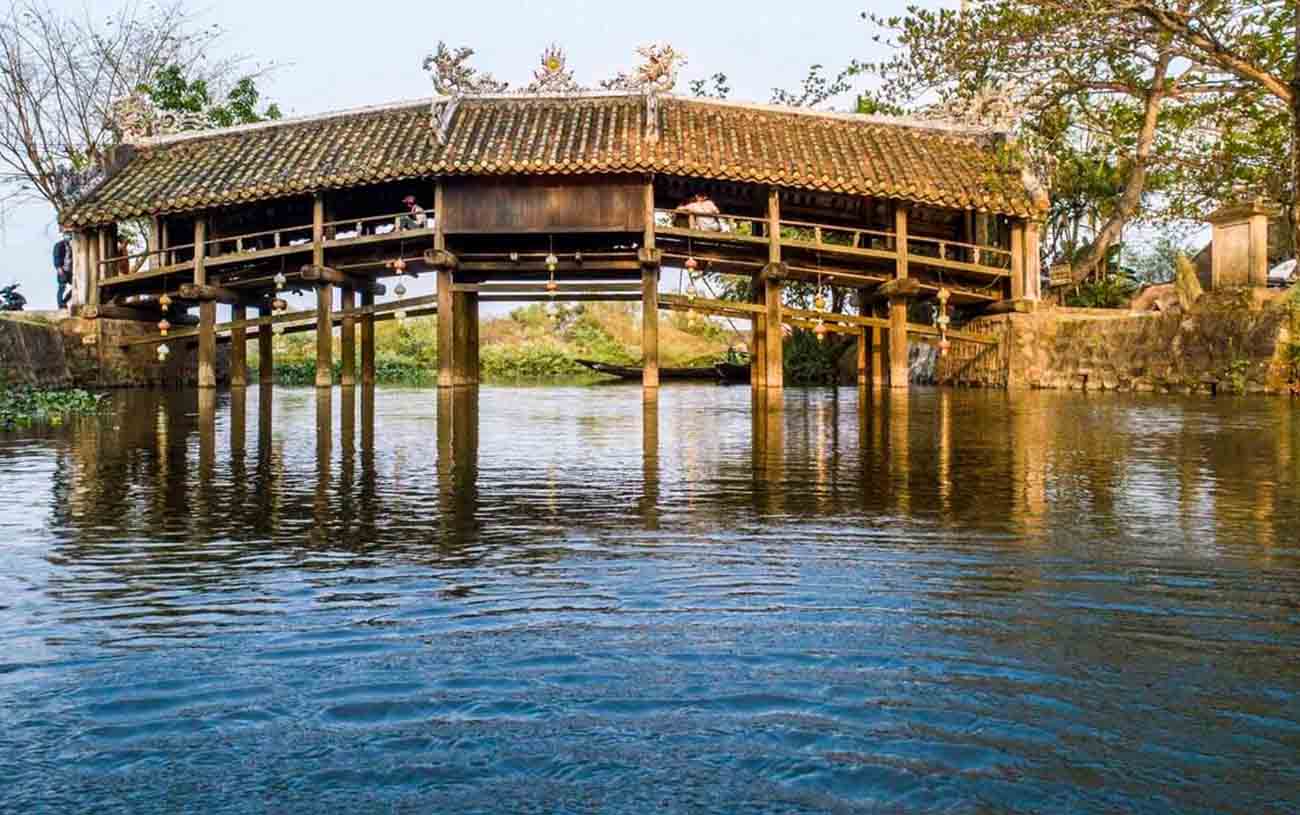
The bridge sits about 7 – 8 km southeast of central Hue in Thanh Thuy Chanh village, surrounded by canals, rice fields, farms, and residential lanes.
The setting is part of what makes the visit worthwhile, but the bigger difference is the history behind the bridge.
What Makes Thanh Toan Bridge Different?
Most of Hue’s best-known historical sites are connected to the Nguyen Dynasty, emperors, royal ceremonies, and court life.
Thanh Toan Bridge comes from a very different background.
It was built for ordinary villagers who needed a practical way to cross the canal. Its covered structure also provided somewhere to sit, rest, and shelter from the sun or rain.
That function is still visible today.
The bridge is not a huge monument with dozens of buildings to inspect. You can take your time looking at the timber structure, tiled roof, altar, and benches and understand fairly quickly why the bridge mattered to the people who lived here.
For travelers who have already seen Hue’s palaces and royal tombs, Thanh Toan adds a useful look at the rural side of local history.
Who Will Enjoy Thanh Toan Bridge?
Thanh Toan is particularly suitable for travelers interested in:
- Traditional architecture
- Cycling
- Photography
- Rural life
- Local history
- Short countryside trips from Hue
The relatively flat route from central Hue also makes the village suitable for cycling when the weather is comfortable.
Families may enjoy the trip as well. There is more open space than in central Hue, and the nearby agricultural museum provides some context for traditional farming and village life.
When I Would Skip It
I wouldn’t force Thanh Toan into a packed one-day Hue itinerary.
If your time is extremely limited, the Imperial City and one of the major royal tombs will probably deserve priority.
Heavy rain is another reason to reconsider the trip.
Thanh Thuy Chanh is a low-lying rural area, and roads can become muddy or flooded during severe monsoon weather. Since much of the visit involves walking or cycling outdoors, conditions matter.
How Much Time Should You Allow?
For most visitors, around 2 – 3 hours including travel from central Hue is comfortable.
If you only want to see the bridge, look around the morning market, and take a short village walk, you can make the trip much quicker.
Allow closer to 3 – 4 hours if you are cycling from Hue, visiting the Agricultural Museum, exploring the village lanes, or stopping for food or coffee.
The important thing is that you don’t need a full day here.
The Story Behind Thanh Toan Bridge
The story of Thanh Toan Bridge is closely connected to Tran Thi Dao, a local woman who financed its construction in 1776.
Unlike many of Hue’s famous historic structures, the bridge was not commissioned for a king or built for royal ceremonies.
It solved an everyday problem for the people living in the village.
Who Built Thanh Toan Bridge?
Tran Thi Dao came from one of Thanh Toan village’s long-established families and was married to a high-ranking mandarin during the reign of Emperor Le Hien Tong.
Historical accounts describe her as a wealthy woman who had no children.
In traditional Vietnamese society, continuing the family line and maintaining ancestor worship carried great importance. She chose to use part of her fortune for the benefit of the local community, and the bridge became her most lasting contribution.
The village itself has an even longer history.
It was established in 1471 by thirteen family lineages from Thanh Hoa who followed King Le Thanh Tong south.
Why Was the Bridge Built?
An irrigation canal divided the village, making everyday movement difficult.
Farmers needed to carry crops, animals, and equipment across the water. Travelers also had little shelter from Hue’s strong sun and heavy rain.
Tran Thi Dao funded a covered bridge that solved both problems.
Villagers could cross the canal more easily, while the roof and wooden seating provided somewhere to stop and rest.
Her contribution was recognized by the royal court. In 1776, Emperor Le Hien Tong praised her work and granted tax exemptions to the village.
Her memory survived long after her death.
In 1925, Emperor Khai Dinh granted her the posthumous title “Duc Bao Trung Hung Linh Phu” and ordered that an altar be maintained for her on the bridge.
That altar remains an important detail when you visit today. It explains why Thanh Toan is not simply an old piece of infrastructure but also a place connected to community memory and worship.
Architecture and Notable Features
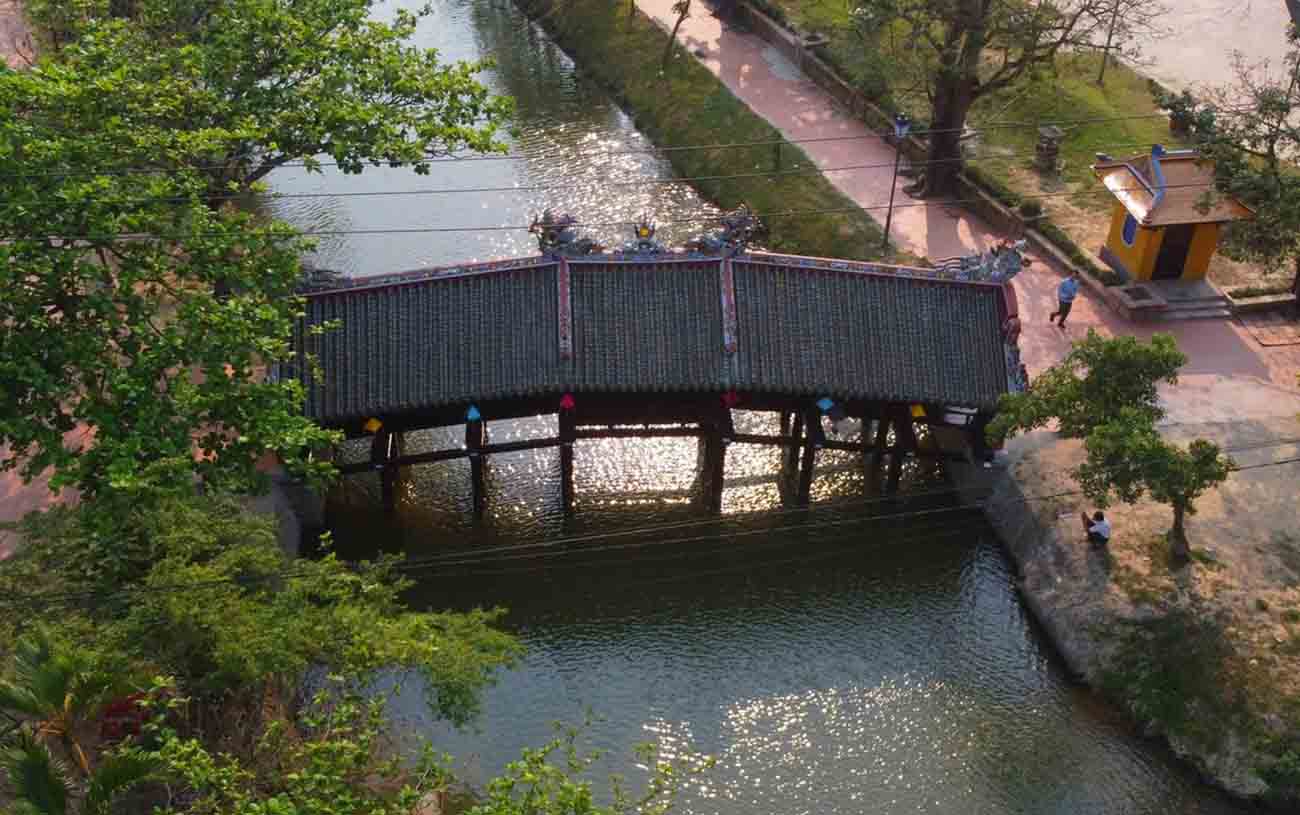
Thanh Toan follows the traditional “Thượng gia, hạ kiều” design, roughly translated as a house above, a bridge below.
That description makes much more sense once you step inside.
The structure was designed not only to cross the canal but also to work as a sheltered communal space.
The bridge measures roughly 17 – 18.75 meters long and 4 – 5.82 meters wide. Its main timber framework is supported by 18 pillars arranged in six rows.
Inside are seven sections.
The central section contains the altar dedicated to Tran Thi Dao. Its floor is slightly raised, allowing small boats to pass underneath.
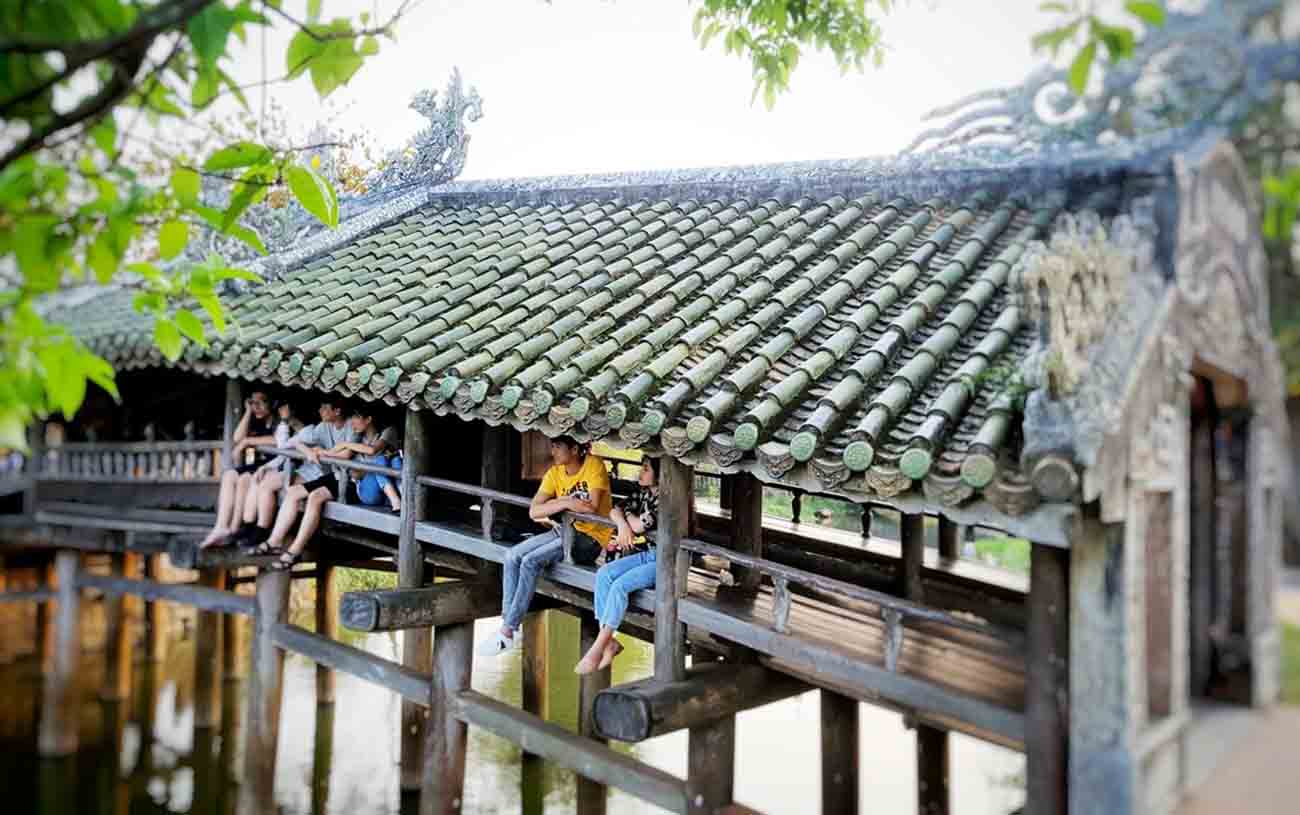
Long wooden platforms run along both sides of the interior.
These were built for people to sit and rest, which is one of the details I find most useful for understanding the bridge. It was never meant to function only as a walkway.
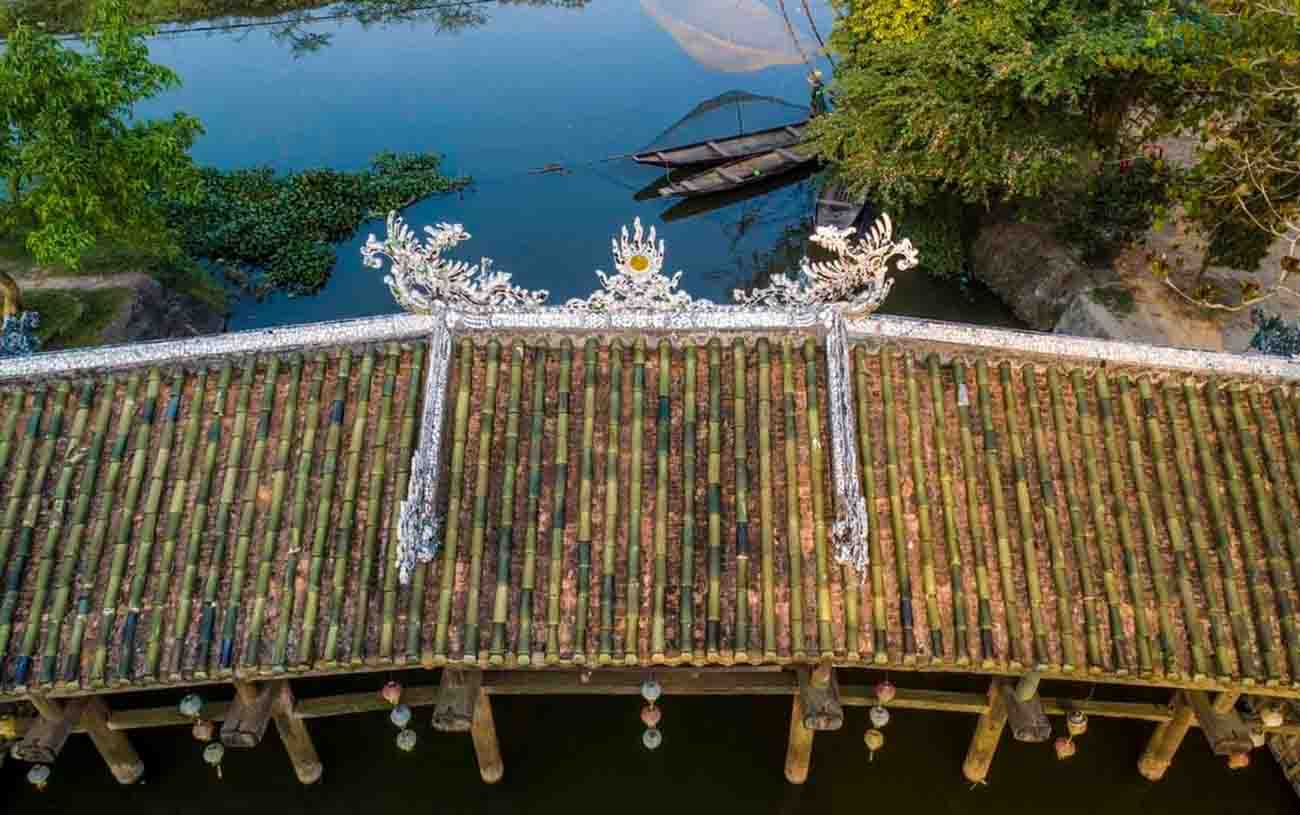
Above is a roof covered in traditional yin-yang ceramic tiles, locally known as ngói lưu ly. The roof protects the interior from both sun and rain and helps keep the space below noticeably cooler.
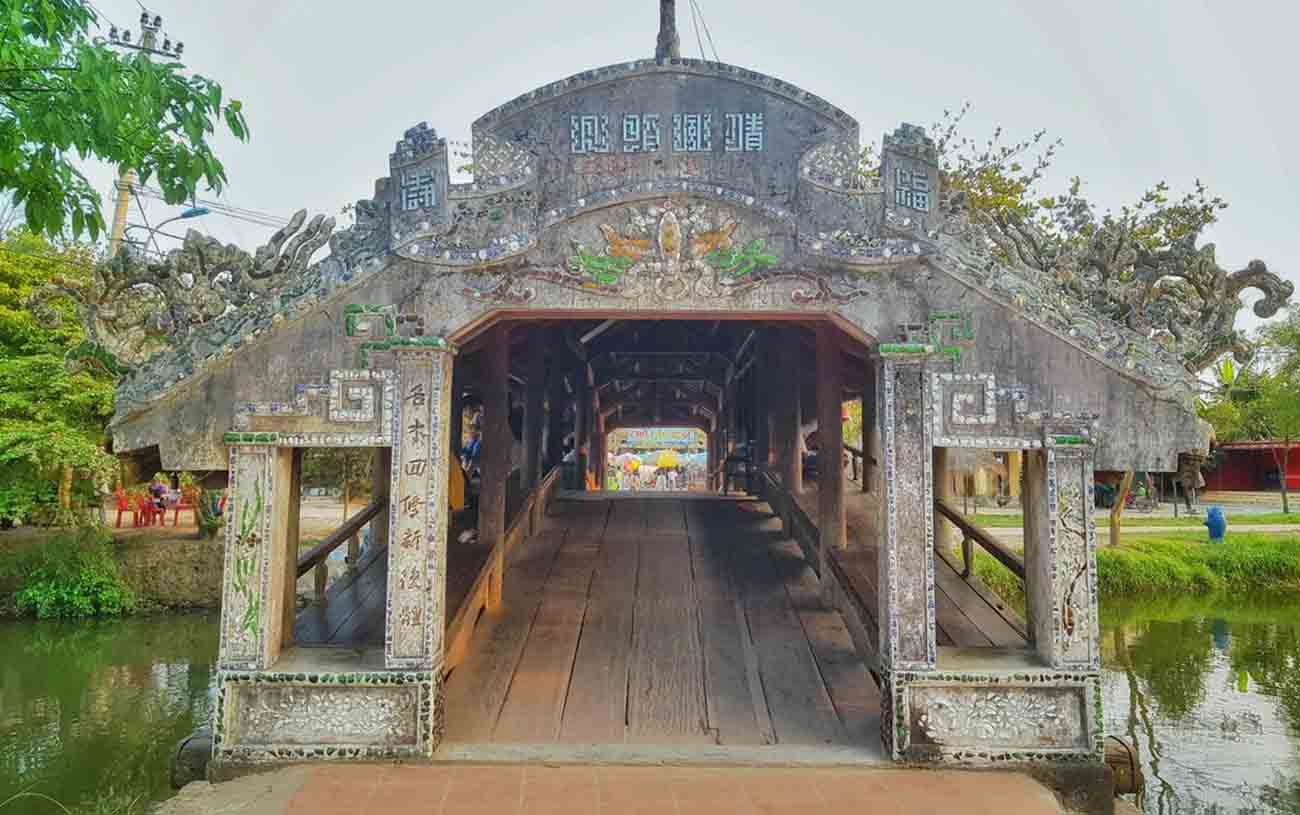
Look along the roofline and you will also see traditional dragon and phoenix motifs.
The bridge has been restored many times, including major work in 1844, 1956, 1971, 1991, 2016, and 2020.
A major typhoon on September 11, 1904 tore away the roof, leading to another community-supported reconstruction.
In 1990, Thanh Toan Bridge was officially recognized as a national art and architecture relic.
Thanh Toan Bridge vs Hoi An’s Japanese Covered Bridge
Thanh Toan is sometimes compared with Hoi An’s Japanese Covered Bridge because both combine a bridge with a roofed structure.
The similarities are obvious, but their histories are quite different.
| Feature | Thanh Toan Bridge | Japanese Covered Bridge |
|---|---|---|
| Origin | Funded by Tran Thi Dao for the local village | Built by the Japanese merchant community |
| Main Purpose | Rural crossing, resting place, community space | Connected commercial areas in a trading town |
| Setting | Canal, village, and rice fields | Historic urban center of Hoi An |
| Architecture | Traditional Vietnamese rural design | Japanese, Chinese, and Vietnamese influences |
| Roof Details | Dragons and phoenixes | Mixed cultural influences |
| Guardian Statues | No prominent animal guardians | Known for dog and monkey statues |
For me, this is the more useful way to compare them:
Hoi An’s bridge tells the story of an international trading town. Thanh Toan tells the story of a Vietnamese farming community.
Neither needs to be treated as a version of the other.
What to See and Do at Thanh Toan Bridge
The bridge is the main reason to come, but it is easy to combine with several small experiences nearby.
Walk Across the Historic Covered Bridge
Don’t rush straight through.
Once underneath the tiled roof, you can feel how much more sheltered the interior is compared with the exposed road outside.
Look at the exposed wooden beams, the floorboards, the roof structure, and the altar in the center.
The timber floor has been worn smooth through generations of use, while traditional decorative details can be seen along the roof.
Fresh incense, flowers, or fruit may also appear around the altar dedicated to Tran Thi Dao.
Sit on the Wooden Platforms
The long raised platforms inside the bridge are not decorative.
They were built as places for villagers to stop and rest, and the bridge continues to function as a shared community space.
Local residents may sit here to talk, take a break from the heat, play board games, or simply watch people passing.
If there is space, sitting down for a few minutes gives you a better sense of how the bridge is actually used.
Explore Thanh Thuy Chanh Village
After seeing the bridge, walk or cycle along some of the public roads around Thanh Thuy Chanh village.
You will pass canals, houses, family temples, ancestral worship halls, farms, and rice fields.
The landscape changes with the farming season. Fields may be green during the growing period or turn golden closer to harvest.
Ducks, buffalo, and small-scale agriculture are also still part of the area.
You don’t need a fixed walking route.
A short wander along the public lanes is enough.
Remember That People Live Here
Thanh Thuy Chanh is a residential village, not an outdoor museum.
Stay on public roads, keep noise reasonable, and don’t enter private family courtyards without permission.
The same applies to photography. If you want a close portrait of someone, ask first.
Visit the Local Market
The market near the bridge is most interesting in the morning.
Depending on the day, you may find vegetables, fresh fish, herbs, spices, and produce from the surrounding area.
Food stalls can also sell local items such as:
- Banh bot loc
- Banh xeo
- Chè
- Sugarcane juice
Traditional products such as nón lá may also be available.
By midday, activity drops considerably as vendors leave or move out of the heat.
On Friday, Saturday, and Sunday evenings, the Cầu Ngói Market area becomes active again from around 6:00 PM, with additional food stalls and cultural activities.
Visit Thanh Toan Agricultural Museum
The Thanh Toan Agricultural Museum is a short walk from the bridge.
If you want to understand the farming landscape around the village rather than simply look at it, the museum is useful.
The collection includes traditional equipment such as:
- Stone rice pounders
- Bamboo fish traps
- Wooden plows
- Terracotta pots
- Traditional clothing
- Farming tools
The displays show how local people farmed and fished before modern machinery became common.
Local women may also demonstrate how some of the equipment was used and occasionally perform traditional folk songs.
Museum Opening Hours and Fees
The museum generally opens:
- Tuesday – Sunday: 8:30 AM – 5:00 PM
- Lunch break: 11:30 AM – 1:30 PM
- Monday: Closed
Typical admission:
- Adults: 20,000 VND
- Children aged 6 – 16: 10,000 VND
Other options include:
- iMuseum VFA smart guide: 50,000 VND
- Private guided visit: 150,000 VND per group
Unlike the bridge, the museum has fixed operating hours, so check the schedule if visiting it is important to you.
Best Time to Visit Thanh Toan Bridge
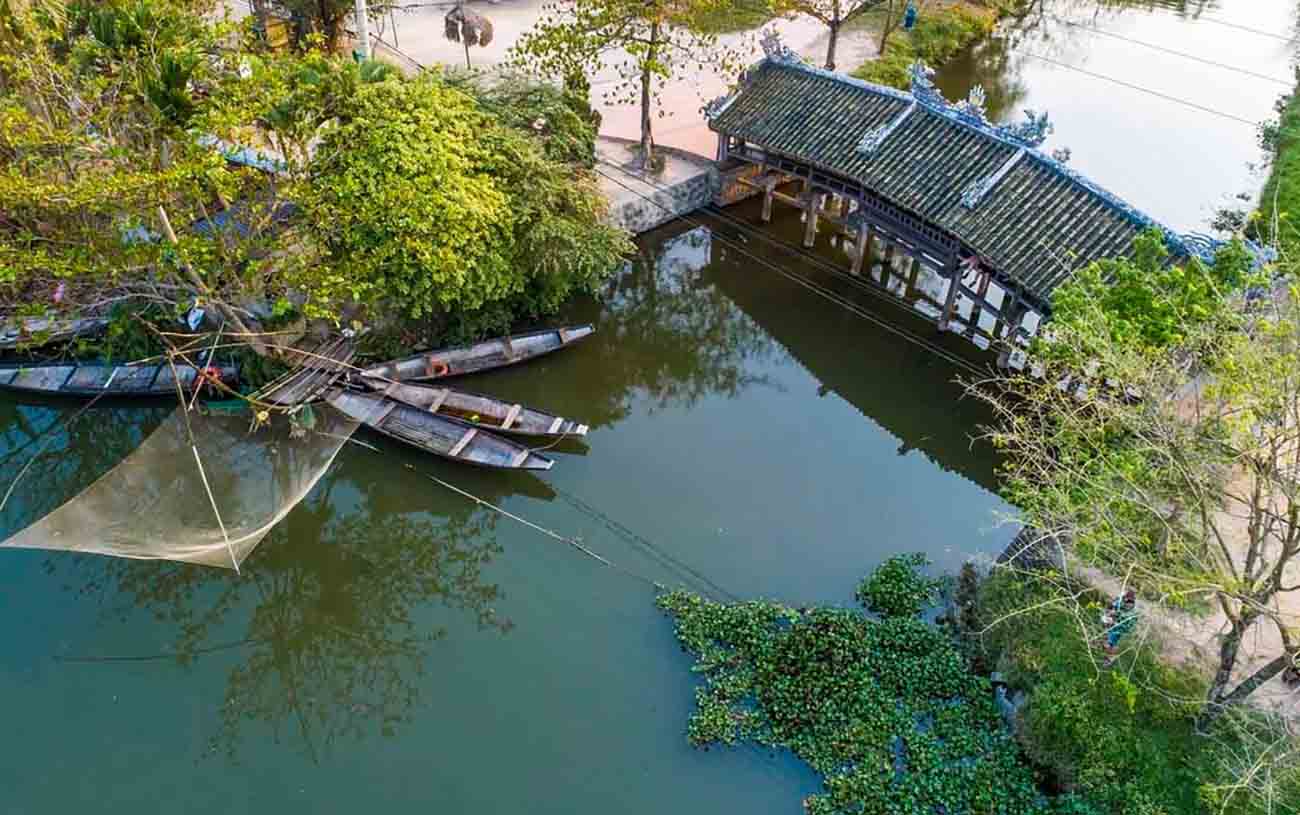
The best time of day is usually early morning or late afternoon.
Midday gives you stronger heat and less market activity without adding much to the experience.
Morning: 7:00 AM to 9:00 AM
Morning would be my first choice if you want to see more of the village in action.
Temperatures are lower, the local market is active, and farmers are already working around the surrounding area.
It is also a much better time for cycling from Hue.
Late Afternoon: 3:30 PM to 5:30 PM
Late afternoon suits photography and a quieter walk.
The light becomes softer, the bridge’s wooden details are easier to photograph, and the glare over the rice fields is less harsh.
Temperatures also begin to drop as villagers return from their work.
Best Months to Visit
The drier period from roughly March to August generally makes walking and cycling easier.
The earlier part of this period is more comfortable.
By June, July, and August, midday temperatures can climb above 38°C (100°F). During those months, avoid the middle of the day if possible.
Rainy Season and Flooding
Hue becomes much wetter from September to December.
Thanh Thuy Chanh is low-lying, so prolonged or heavy rain can cause muddy roads, localized flooding, and difficult access.
This is especially important if you plan to cycle or ride a motorbike.
Check the forecast before leaving central Hue rather than assuming conditions will remain the same for the whole trip.
Visiting During Local Festivals
Festival days offer a very different experience.
On the third day of Tet, the village hosts a traditional Bai Choi festival featuring folk singing, poetry, and community games.
On the 15th day of the 8th lunar month, villagers hold a ceremony honoring Tran Thi Dao, including a procession, traditional games, and boat racing.
The village may also host countryside activities during the Hue Festival.
Because these celebrations follow the lunar calendar or individual festival schedules, confirm dates before planning around them.
If you want a quiet visit, avoid major event days.
If you want more community activity, they can be some of the most interesting times to come.
How to Get to Thanh Toan Bridge from Hue
Thanh Toan Bridge is around 7 – 8 km from central Hue.
You can get there by bicycle, motorbike, Grab, taxi, private car, or as part of a countryside tour.
By Bicycle
When the weather is comfortable, cycling is probably the most interesting way to get there.
The route is largely flat, and the distance is reasonable for anyone comfortable riding several kilometers.
After leaving the busier city streets, the surroundings gradually change to rice fields, canals, farms, and residential roads.
A common route heads along To Huu Street, toward Hoang Quoc Viet Street, then continues onto smaller roads toward Thuy Thanh commune.
Allow roughly 30 – 45 minutes each way.
Bring water and sun protection, and check your brakes and tires before leaving.
I would avoid cycling around midday during the hotter months.
By Motorbike or Scooter
By motorbike, the journey takes roughly 15 minutes.
It is convenient and flexible, particularly when the weather is too hot for cycling.
Only choose this option if you are already comfortable riding in Vietnam.
Although the rural roads are quieter, you may still encounter potholes, livestock, or slow agricultural vehicles.
Wear a helmet and ride defensively.
Parking is available around the market and museum area for roughly 5,000 VND.
By Grab, Taxi or Private Car
A car is the simplest option for families, groups, older visitors, or anyone traveling during very hot or rainy weather.
Grab and taxis operate in central Hue and can take you directly to the village.
The return journey needs a little more thought.
Thanh Thuy Chanh is rural, so taxis are not constantly passing and a nearby Grab driver may not always be available immediately.
If you don’t want to deal with that, arrange a return pickup or ask your driver to wait.
By Guided Countryside Tour
A guided tour is useful when you want more explanation about the village rather than just transport.
Tours may travel by bicycle, jeep, or other forms of transport and can include additional countryside stops.
A guide can add context around the bridge’s history, agriculture, ancestor worship, and architecture.
Before booking, check the group size, museum admission, transport, meals, bicycle quality if relevant, and whether an English-speaking guide is included.
For independent travelers, I would choose a bicycle in comfortable weather and a car when heat or rain makes cycling less appealing.
Essential Visitor Information
| What to Know | Details |
|---|---|
| Distance from central Hue | Around 7 – 8 km southeast |
| By motorbike/car | Around 15 minutes |
| By bicycle | Around 30 – 45 minutes |
| Thanh Toan Bridge admission | Free |
| Agricultural Museum | 20,000 VND adults; 10,000 VND ages 6 – 16; free under 6 and disabled visitors |
| Smart guide | 50,000 VND |
| Typical visit | Around 1.5 – 2 hours onsite, excluding travel |
| Food and drinks | Market, small cafés, coffee, sugarcane juice, simple food |
| Toilets | Near the museum |
| Parking | Bicycle and scooter parking available for a small fee |
Accessibility
The village roads and museum area are generally flat.
The bridge itself is more difficult.
Its old wooden floor is uneven and includes raised sections, so wheelchair users and travelers with significant mobility limitations may find crossing challenging.
The bridge can still be viewed from the paved banks beside the canal.
Check Local Opening Times
The bridge itself can be accessed much more freely than the surrounding attractions.
The museum closes on Mondays, takes a lunch break, and closes at 5:00 PM.
The rural market is most active early in the morning.
The weekend night market starts from around 6:00 PM.
If either the market or museum is important to your trip, plan around those hours rather than simply arriving whenever convenient.
Suggested Thanh Toan Bridge Itineraries
You can make Thanh Toan a short side trip or spend a more relaxed half-day in the countryside.
Quick Visit from Hue
If your schedule is tight, around 1.5 hours can work when traveling by taxi or car.
Go in the morning, walk across the bridge, look through the market, have a quick look around the canal and nearby lanes, then return to Hue.
This works if the bridge itself is your main priority.
Relaxed Half-Day Countryside Trip
With more time, cycling makes the visit more enjoyable.
Ride out from Hue in the morning, spend some time looking around the bridge, visit the Agricultural Museum, walk or cycle through the surrounding village, and stop around the rice fields and ancestral halls.
You can finish with a coffee or simple local meal before returning to the city.
This is the option I would choose when the weather is good and there is no need to rush back.
Try to complete the cycling portion before the strongest midday heat.
Practical Tips for Visiting Thanh Toan Bridge
- Go early. Before 9:00 AM gives you cooler weather and more market activity.
- Carry water and sun protection. Rural roads have limited shade.
- Bring some Vietnamese cash. Small vendors, parking, and museum services may be easier to pay for in cash.
- Take a poncho during the wet season. Rain can arrive quickly between September and December.
- Ask before taking close-up photographs of residents.
- Keep the bridge clear. People still use it, so don’t block the walkway for long photo sessions.
- Expect rural schedules to be flexible. Vendors may close earlier when business is slow, produce sells out, or the weather becomes too hot.
- Be respectful around the altar. Keep your voice down and don’t climb on the wooden railings or altar area.
Thanh Toan is easy to visit, but it is still a place where people live, work, worship, and meet.
Keeping that in mind makes the experience better for everyone.
Final Thoughts
Thanh Toan Bridge is worth adding to a Hue itinerary when you have a few hours to explore outside the city center.
The architecture is interesting, and the story of Tran Thi Dao gives the bridge more meaning once you understand why it was built.
But I wouldn’t separate the bridge completely from its surroundings.
See the old timber structure, sit inside for a few minutes, walk through the village, visit the market if your timing is right, and add the Agricultural Museum if you want more context.
That combination is what makes the trip worthwhile.
Thanh Toan doesn’t need to compete with Hue’s Imperial City or royal tombs. It shows a different part of local history — one built around farmers, families, and everyday village life.